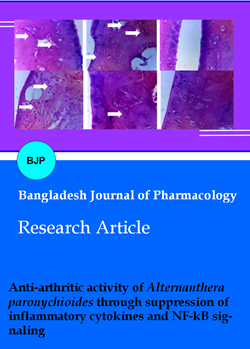
Anti-arthritic activity of Alternanthera paronychioides through suppression of inflammatory cytokines and NF-κB signaling
Keywords:
Alternanthera paronychioides, Rheumatoid arthritis, PPAR/NF-κB signalingAbstract
Alternanthera paronychioides is traditionally used for managing inflammatory disorders; however, its anti-arthritic efficacy and underlying mechanisms remain insufficiently characterized. The present study evaluated the anti-arthritic potential of A. paronychioides in acute and chronic animal models of arthritis. Previously, sequential extracts were assessed for inhibition of protein denaturation, proteinase activity, and erythrocyte membrane destabilization. The most active n-hexane extract was further investigated in carrageenan-induced inflammation and complete Freund’s adjuvant-induced arthritis in rats. n-Hexane extract treatment significantly reduced paw edema, arthritic severity, hyperalgesia, and allodynia, while improving histopathological, and radiographic outcomes. Molecular analysis revealed marked suppression of pro-inflammatory mediators, including TNF-α, IL-1β, IL-6, NF-κB, and COX-2, alongside up-regulation of IL-4. These findings demonstrate that A. paronychioides exerts potent anti-arthritic effects through multi-target immunomodulation.
348
240
References
Atkinson SM, Usher PA, Kvist PH, Markholst H, Haase C, Nansen A. Establishment and characterization of a sustained delayed-type hypersensitivity model with arthritic manifestations in C57BL/6J mice. Arthritis Res Ther. 2012; 14: R134.
Azwanida NN. A review on the extraction methods use in medicinal plants, principle, strength and limitation. Med aromat plants. 2015; 4: 196.
Biella CD, Salvador MJ, Dias DA, Dias-Baruffi M, Pereira-Crott LS. Evaluation of immunomodulatory and anti-inflammatory effects and phytochemical screening of Alternanthera tenella Colla (Amaranthaceae) aqueous extracts. Mem Inst Oswaldo Cruz. 2008; 103: 569-77.
Brand DD, Latham KA, Rosloniec EF. Collagen-induced arthritis. Nat Protoc. 2007; 2: 1269-75.
Chen X, Zhang H, Zeng W, Wang N, Lo HH, Ip CK, Yang LJ, Hsiao WW, Sin WM, Xia C, Law BY, Wong VK. Far infrared irradiation suppresses experimental arthritis in rats by down-regulation of genes involved inflammatory response and autoimmunity. J Adv Res. 2022; 38: 107-18.
Deuis JR, Dvorakova LS, Vetter I. Methods used to evaluate pain behaviors in rodents. Front Mol Neurosci. 2017; 10: 284.
Esser RE, Hildebrand AR, Angelo RA, Watts LM, Murphey MD, Baugh LE. Measurement of radiographic changes in adjuvant-induced arthritis in rats by quantitative image analysis. Arthritis Rheum. 1995; 38: 129-38.
Gunn A, Bobeck EN, Weber C, Morgan MM. The influence of non-nociceptive factors on hot-plate latency in rats. J Pain. 2011; 12: 222-27.
Liao H, Zheng J, Lu J, Shen H. NF-κB signaling pathway in rheumatoid arthritis: Mechanisms and therapeutic potential. Mol Neurobiol. 2025; 62: 6998-7021.
Loza-Mejía MA, Salazar JR. Sterols and triterpenoids as potential anti-inflammatories: Molecular docking studies for binding to some enzymes involved in inflammatory path-ways. J Mol Graphics Modell. 2015; 62: 18-25.
Manan M, Saleem U, Ahmad B, Aslam N, Anwar A, Zafar A. Anti-arthritic and toxicological evaluation of ethanolic extract of Alternanthera bettzickiana in rats. Front Pharmacol. 2022; 13.
Manan M, Saleem U, Akash MS, Qasim M, Hayat M, Raza Z, Ahmad B. Antiarthritic potential of comprehensively standardized extract of Alternanthera bettzickiana: In vitro and in vivo studies. ACS Omega. 2020; 5: 19478-96.
Mandal AK, Allu R, Chandran R, Gopi DK, Narayana SK, Prakasam R, Ramachandran S. Chemical characterization of two botanicals from genus Alternanthera: A. brasiliana (L.) Kuntze and A. paronychioides A. St.-Hil. Pharmacogn Res. 2023; 16: 42-50.
Marchete R, Oliveira S, Bagne L, Silva JI, Valverde AP, Aro AA, Figueira MM, Fronza M, Bressam TM, Goes VF, Gaspari de Gaspi FO, Dos Santos GM, Andrade TA. Anti-inflammatory and antioxidant properties of Alternanthera brasiliana improve cutaneous wound healing in rats. Inflammopharmacology 2021; 29: 1443-58.
McInnes IB, Schett G. Pathogenetic insights from the treatment of rheumatoid arthritis. Lancet 2017; 389: 2328-37.
Mohd Razali NN, Teh SS, Mah SH, Yong YK, Ng CT, Lim YM, Fong LY. Protective effects of Alternanthera sessilis ethanolic extract against TNF-α or H2O2-induced endothelial activa-tion in human aortic endothelial cells. Evid Based Complement Alternat Med. 2022; 8738435.
Necas J, Bartosikova L. Carrageenan: A review. Vet Med. 2013; 58: 187-205.
Parent AJ, Beaudet N, Beaudry H, Bergeron J, Berube P, Drolet G, Sarret P, Gendron L. Increased anxiety-like behaviors in rats experiencing chronic inflammatory pain. Behav Brain Res. 2012; 229: 160-67.
Pelisoli Formagio EL, Mendel MT, Fracasso R, Knobloch JG, Teixeira PW, Kehl L, Maluf RW, Picoli SU, Ardenghi P, Suyenaga ES. Evaluation of the pharmacological activity of the Alternanthera brasiliana aqueous extract. Pharm Biol. 2012; 50: 1442-47.
Sharma P, Saini S, Hasanpuri P, Kataria N, Kumar V, Singh P, Sharma A. Recent progress in research on ethnobotany, phytochemistry, pharmacology, and toxicology of some wild plants of family Amaranthaceae: An updated review. Beni Suef Univ J Basic Appl Sci. 2025; 14: 87.
Smolen JS, Aletaha D, Koeller M, Weisman MH, Emery P. New therapies for treatment of rheumatoid arthritis. Lancet 2007; 370: 1861-74.
Vinegar R, Schreiber W, Hugo R. Biphasic development of carrageenin edema in rats. J Pharmacol Exp Ther. 1969; 166: 96-103.
Wu CH, Hsieh HT, Lin JA, Yen GC. Alternanthera paronychioides protects pancreatic β-cells from glucotoxicity by its antioxidant, antiapoptotic and insulin secretagogue actions. Food Chem. 2013; 139: 362-70.
Downloads
Published
How to Cite
Issue
Section
License
Copyright (c) 2026 Mehnaz Ghulam Nabi, Naureen Shehzadi, Muhammad Tanveer Khan, Khalid Hussain

This work is licensed under a Creative Commons Attribution 4.0 International License.
Authors who publish with this journal agree to the following terms:
- Authors retain copyright and grant the journal right of first publication with the work simultaneously licensed under a Creative Commons Attribution License that allows others to share the work with an acknowledgement of the work's authorship and initial publication in this journal.
- Authors are able to enter into separate, additional contractual arrangements for the non-exclusive distribution of the journal's published version of the work (e.g., post it to an institutional repository or publish it in a book), with an acknowledgement of its initial publication in this journal.
- Authors are permitted and encouraged to post their work online (e.g., in institutional repositories or on their website) prior to and during the submission process, as it can lead to productive exchanges, as well as earlier and greater citation of published work (See The Effect of Open Access).

