Socio-demographic characteristics, clinical pattern, and mental health status of gender dysphoria patients in a tertiary care hospital of Bangladesh
Keywords:
Gender Dysphoria, Depression, Anxiety, Mental Health, BangladeshAbstract
Background: Gender dysphoria is characterized by marked incongruence between the assigned gender at birth and the experienced gender, leading to significant emotional distress affecting mental health, social interactions, and overall well-being. In Bangladesh, published data on patients with gender dysphoria remain scarce, and persistent social stigma, discrimination, and barriers to care continue to affect timely help-seeking and access to appropriate psychological support.
Objectives: To determine the socio-demographic characteristics, clinical pattern, and mental health status of patients with gender dysphoria.
Methods: This cross-sectional study was conducted at the Department of Endocrinology, Dhaka Medical College Hospital, from January to December 2024. Fifty patients with gender dysphoria were enrolled using purposive sampling. Participants underwent a detailed assessment, including socio-demographic characteristics, clinical pattern evaluation, and mental health status assessment using the validated Bangla version of the Depression Anxiety Stress Scale-21 (DASS-21). Data were analyzed using Statistical Package for Social Sciences (SPSS) version 27 (IBM Corp., Armonk, NY).
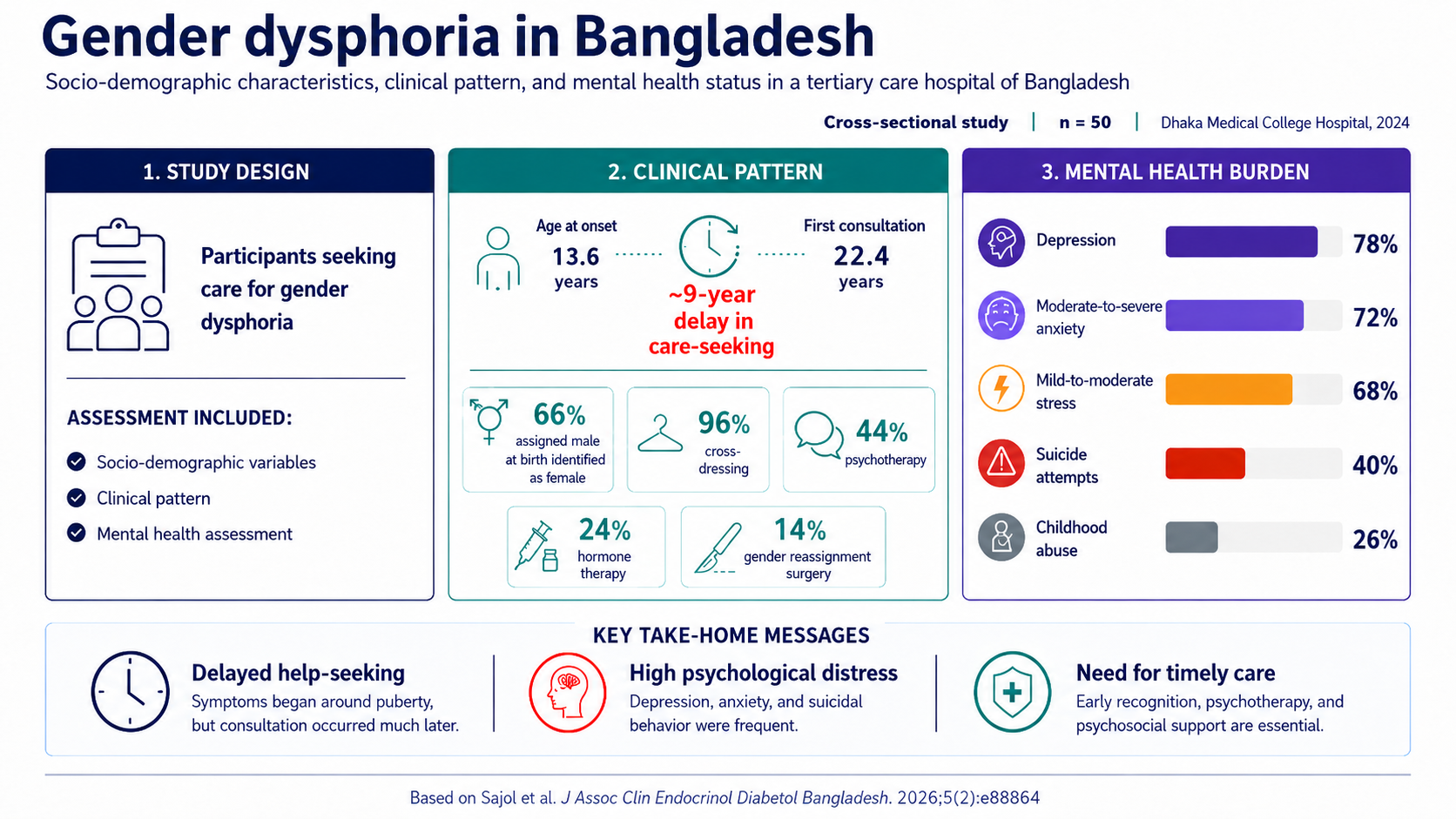
Results: The mean age was 26.16±9.99 years, with most participants being students (48%) and single (84%). Mean age of onset of gender dysphoria was 13.56±7.38 years, while first consultation occurred at 22.36±7.98 years. Among participants, 66% assigned male at birth identified as female, 96% engaged in cross-dressing, 44% received psychotherapy, 24% underwent hormone therapy, and 14% had gender reassignment surgery. Mental health assessment revealed 78% had depression (ranging from mild to severe), 72% experienced moderate to severe anxiety, and 40% reported suicide attempts.
Conclusions: Gender dysphoria patients in Bangladesh demonstrate a significant mental health burden with high rates of depression, anxiety, and suicidal behavior. Early recognition and timely multidisciplinary care, with psychotherapy and psychosocial support at its core, are essential to address mental health needs in this vulnerable population.
[J Assoc Clin Endocrinol Diabetol Bangladesh, July 2026; 5 (2): e88864]
209
58
References
1. American Psychiatric Association. Diagnostic and Statistical Manual of Mental Disorders. 5th ed. Arlington, Virginia: American Psychiatric Association; 2013. DOI: https://doi.org/10.1176/appi.books.9780890425596
2. Coleman E, Radix AE, Bouman WP, Brown GR, de Vries ALC, Deutsch MB, et al. Standards of care for the health of transgender and gender diverse people, version 8. Int J Transgend Health 2022;23(Suppl 1):S1-S259. DOI: https://doi.org/10.1080/26895269.2022.2100644
3. Wiepjes CM, Nota NM, de Blok CJM, Klaver M, de Vries ALC, Wensing-Kruger SA, et al. The Amsterdam cohort of gender dysphoria study (1972–2015): trends in prevalence, treatment, and regrets. J Sex Med 2018;15(4):582-90. DOI: https://doi.org/10.1016/j.jsxm.2018.01.016
4. Cheung AS, Ooi O, Leemaqz S, Cundill P, Silberstein N, Bretherton I, et al. Sociodemographic and clinical characteristics of transgender adults in Australia. Transgend Health 2018;3(1):229-38. DOI: https://doi.org/10.1089/trgh.2018.0019
5. Zhang Q, Goodman M, Adams N, Corneil T, Hashemi L, Kreukels B, et al. Epidemiological considerations in transgender health: a systematic review with focus on higher quality data. Int J Transgend Health 2020;21(2):125-37. DOI: https://doi.org/10.1080/26895269.2020.1753136
6. Oshima Y, Matsumoto Y, Terada S, Yamada N. Prevalence of gender dysphoria by gender and age in Japan: a population-based internet survey using the Utrecht Gender Dysphoria Scale. J Sex Med 2022;19(7):1185-95. DOI: https://doi.org/10.1016/j.jsxm.2022.03.605
7. Meyer G, Mayer M, Mondorf A, Herrmann E, Bojunga J. Increasing normality–persisting barriers: current socio-demographic characteristics of 350 individuals diagnosed with gender dysphoria. Clin Endocrinol (Oxf) 2020;92(3):241-46. DOI: https://doi.org/10.1111/cen.14140
8. Olson J, Schrager SM, Belzer M, Simons LK, Clark LF. Baseline physiologic and psychosocial characteristics of transgender youth seeking care for gender dysphoria. J Adolesc Health 2015;57(4):374-80. DOI: https://doi.org/10.1016/j.jadohealth.2015.04.027
9. Khatchadourian K, Amed S, Metzger DL. Clinical management of youth with gender dysphoria in Vancouver. J Pediatr 2014;164(4):906-11. DOI: https://doi.org/10.1016/j.jpeds.2013.10.068
10. Steensma TD, McGuire JK, Kreukels BPC, Beekman AJ, Cohen-Kettenis PT. Factors associated with desistence and persistence of childhood gender dysphoria: a quantitative follow-up study. J Am Acad Child Adolesc Psychiatry 2013;52(6):582-90. DOI: https://doi.org/10.1016/j.jaac.2013.03.016
11. de Vries ALC, McGuire JK, Steensma TD, Wagenaar ECF, Doreleijers TAH, Cohen-Kettenis PT. Young adult psychological outcome after puberty suppression and gender reassignment. Pediatrics 2014;134(4):696-704. DOI: https://doi.org/10.1542/peds.2013-2958
12. Witcomb GL, Bouman WP, Claes L, Brewin N, Crawford JR, Arcelus J. Levels of depression in transgender people and its predictors: results of a large matched control study with transgender people accessing clinical services. J Affect Disord 2018;235:308-15. DOI: https://doi.org/10.1016/j.jad.2018.02.051
13. Bouman WP, Claes L, Brewin N, Crawford JR, Millet N, Fernandez-Aranda F, et al. Transgender and anxiety: a comparative study between transgender people and the general population. Int J Transgenderism 2017;18(1):16-26. DOI: https://doi.org/10.1080/15532739.2016.1258352
14. Owen-Smith AA, Gerth J, Sineath RC, Barzilay J, Becerra-Culqui TA, Getahun D, et al. Association between gender confirmation treatments and perceived gender congruence, body image satisfaction, and mental health in a cohort of transgender individuals. J Sex Med 2018;15(4):591-600. DOI: https://doi.org/10.1016/j.jsxm.2018.01.017
15. Hendricks ML, Testa RJ. A conceptual framework for clinical work with transgender and gender nonconforming clients: an adaptation of the Minority Stress Model. Prof Psychol Res Pract 2012;43(5):460-67. DOI: https://doi.org/10.1037/a0029597
16. Peterson CM, Matthews A, Copps-Smith E, Conard LA. Suicidality, self-harm, and body dissatisfaction in transgender adolescents and emerging adults with gender dysphoria. Suicide Life Threat Behav 2017;47(4):475-82. DOI: https://doi.org/10.1111/sltb.12289
17. Adams N, Hitomi M, Moody C. Varied reports of adult transgender suicidality: synthesizing and describing the peer-reviewed and gray literature. Transgend Health 2017;2(1):60-75. DOI: https://doi.org/10.1089/trgh.2016.0036
18. Grossman AH, Park JY, Russell ST. Transgender youth and suicidal behaviors: applying the interpersonal psychological theory of suicide. J Gay Lesbian Ment Health 2016;20(4):329-49. DOI: https://doi.org/10.1080/19359705.2016.1207581
19. Khan SI, Hussain MI, Parveen S, Bhuiyan MI, Gourab G, Sarker GF, et al. Living on the extreme margin: social exclusion of the transgender population (Hijra) in Bangladesh. J Health Popul Nutr 2009;27(4):441-51. DOI: https://doi.org/10.3329/jhpn.v27i4.3388
20. Alim SAHM, Kibria SME, lslam MJ, Uddin MZ, Nessa M, Wahab MA, et al. Translation of DASS 21 into Bangla and validation among medical students. Bangladesh J Psychiatry 2014;28(2):67-70. DOI: https://doi.org/10.3329/bjpsy.v28i2.32740
21. Wilkinson L, Shifrer D, Pearson J. Educational outcomes of gender-diverse youth: a national population-based study. Gend Soc 2021;35(5):806-37. DOI: https://doi.org/10.1177/08912432211038689
22. Zaliznyak M, Yuan N, Bresee C, Freedman A, Garcia MM. How early in life do transgender adults begin to experience gender dysphoria? Why this matters for patients, providers, and for our healthcare system. Sex Med 2021;9(6):100448. DOI: https://doi.org/10.1016/j.esxm.2021.100448
23. Cooper K, Russell A, Mandy W, Butler C. The phenomenology of gender dysphoria in adults: a systematic review and meta-synthesis. Clin Psychol Rev 2020;80:101875. DOI: https://doi.org/10.1016/j.cpr.2020.101875
24. Hembree WC, Cohen-Kettenis PT, Gooren L, Hannema SE, Meyer WJ, Murad MH, et al. Endocrine treatment of gender-dysphoric/gender-incongruent persons: an Endocrine Society clinical practice guideline. J Clin Endocrinol Metab 2017;102(11):3869-903. DOI: https://doi.org/10.1210/jc.2017-01658
25. Unger CA. Hormone therapy for transgender patients. Transl Androl Urol 2016;5(6):877-84. DOI: https://doi.org/10.21037/tau.2016.09.04
26. Perez-Brumer A, Hatzenbuehler ML, Oldenburg CE, Bockting W. Individual- and structural-level risk factors for suicide attempts among transgender adults. Behav Med 2015;41(3):164-71. DOI: https://doi.org/10.1080/08964289.2015.1028322
27. Shuvo TA, Hossain K, Asma-Ul-Hosna, Dey DR. Suicide attempts in Bangladesh: prevalence, trends, and disparities. Journal of Medicine, Surgery, and Public Health 2025;5:100170. DOI: https://doi.org/10.1016/j.glmedi.2024.100170
28. Bauer GR, Scheim AI, Pyne J, Travers R, Hammond R. Intervenable factors associated with suicide risk in transgender persons: a respondent driven sampling study in Ontario, Canada. BMC Public Health 2015;15:525. DOI: https://doi.org/10.1186/s12889-015-1867-2
29. Angelakis I, Gillespie EL, Panagioti M. Childhood maltreatment and adult suicidality: a comprehensive systematic review with meta-analysis. Psychol Med 2019;49(7):1057-78. DOI: https://doi.org/10.1017/S0033291718003823
Downloads
Published
How to Cite
Issue
Section
License
Copyright (c) 2026 Md. Mosfaqur Rahman Sajol, Shahinoor Siddiqui, Jannatul Asefeen, Rusafa Nazia Murshed, Md. Ebrahim Khalil, K M Istiak Rohan, Md Humayun Kabir, Anaya Saha Banna, Md. Firoz Hossain, Afsar Ahammed, Moinul Islam, Mirza Sharifuzzaman, M. Saifuddin, Indrajit Prasad

This work is licensed under a Creative Commons Attribution-NonCommercial 4.0 International License.
Articles in the JACEDB are licensed under a Creative Commons CC BY-NC License Attribution-Noncommercial 4.0 International (CC BY-NC 4.0). This license permits Share— copy and redistribute the material in any medium or format, Adapt — remix, transform, and build upon the material.

